Asphalt Calculator
Enter the paved area and the compacted thickness to get the tons of asphalt to order, the volume and the truckloads.
This asphalt calculator estimates how many tons or tonnes of hot-mix asphalt you need for a rectangle, a circle, or an area you already know. You enter the size and the compacted thickness, and it returns the amount to order, the volume, and the number of truckloads. It works as an asphalt estimator and pavement calculator, and blacktop and tarmac are other names for the same material. It runs in your browser, is free, and needs no sign-up.
You can type dimensions in US or metric units, and the tool converts them before it calculates. Results show in cubic yards and US tons when you start with feet, inches, or yards, and in cubic meters and tonnes when you start with meters, centimeters, or millimeters. Optional settings let you add a waste allowance, change the density, set the truck capacity, and enter your supplier’s price.
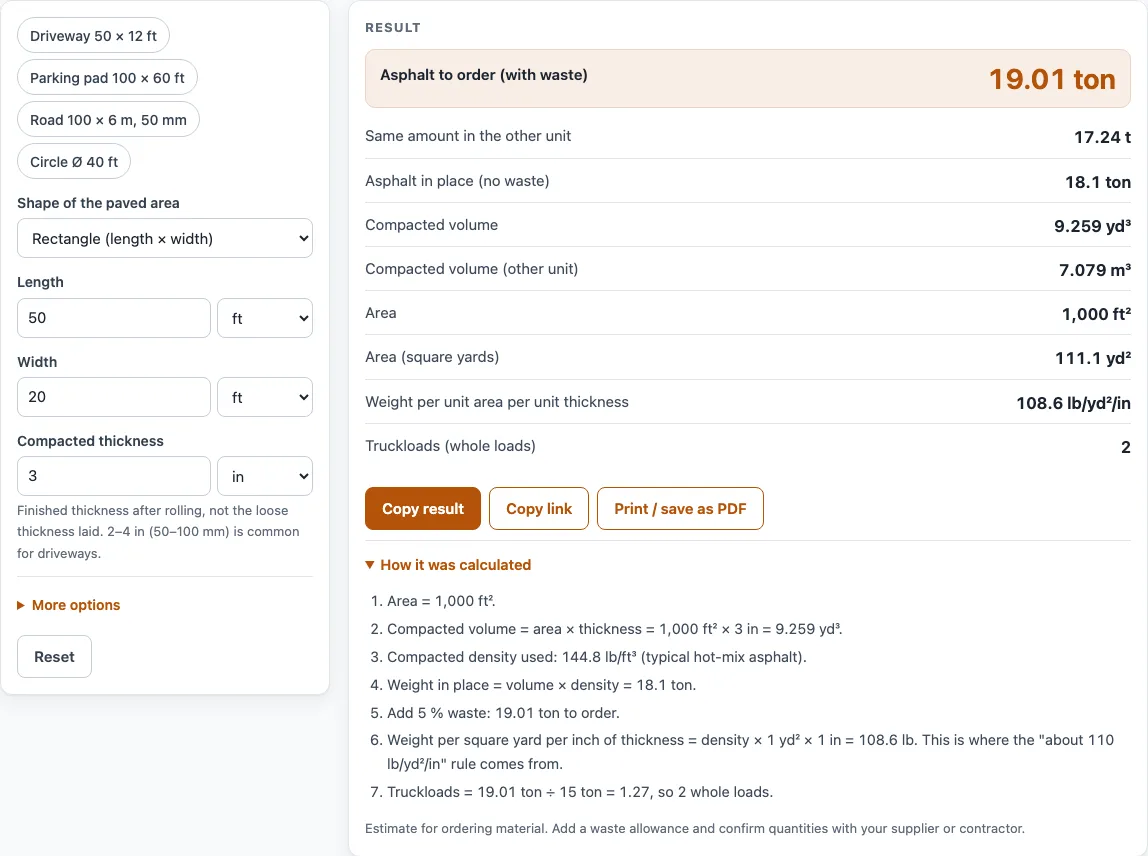
How to use the Asphalt calculator
- Choose Shape of the paved area: Rectangle (length × width), Circle (diameter), or I know the area.
- Enter the size. For a rectangle, fill in Length and Width. For a circle, fill in Diameter. For a known area, fill in Area. Pick the unit next to each box.
- Enter Compacted thickness in in, cm, mm, or ft. Use the finished thickness after rolling, not the loose depth laid.
- Open More options if you need them. Set Waste / extra (%). The 5 % default is only a starting value; use your own allowance.
- Leave Compacted density (optional) empty to use 146.7 lb/ft³ (2,349 kg/m³), which is the 110 lb per square yard per inch design rate in Virginia DOT memo IIM-LD-158, or enter the figure from your mix ticket.
- Enter Truck capacity in ton or t to see how many whole loads you need.
- Enter Price per ton or tonne (optional), then choose the matching option in Price is per. Nothing is filled in for you.
- Read the results, then check How it was calculated to see each step with your numbers.
The example buttons above the form load preset sizes. Reset restores the default values. Copy link saves every input in the page address, so the same calculation reopens later. Copy result copies the result lines with that link, and Print / save as PDF prints the inputs, results, steps, and date.
How many tons of asphalt do I need?
You need the volume of the finished layer, converted to weight, plus a waste allowance. Start with the area and multiply by the compacted thickness. Then multiply by the density, and add the waste percentage.
For a 50 × 20 ft driveway at 3 in, the area is 1,000 ft². Multiplied by 3 in, the compacted volume is 9.259 yd³. At 146.7 lb/ft³, that weighs about 18.3 ton. Adding 5 % waste brings the order to 19.25 ton. With a 15 ton truck, 19.25 ÷ 15 = 1.28, so you need 2 whole loads.
Figuring asphalt tonnage: how do you calculate it?
Asphalt tonnage equals area × compacted thickness × density. Keep the units consistent before you multiply. One cubic yard is 27 cubic feet, and one cubic meter is about 35.31 cubic feet.
The tool’s default is the design rate in Virginia DOT memo IIM-LD-158: 110 lb per square yard for each inch of compacted thickness, which is 146.7 lb/ft³ or 2,349 kg/m³. Other state DOTs use slightly different rates (Tennessee, for example, 105–106 lb per square yard per inch for its surface mixes), so use your plant’s mix design when you have it. A quick check is to multiply the area in square yards by the thickness in inches, then by 110, and divide by 2,000 for US tons; with the default density it matches the tool.
Metric example: a 100 × 6 m road at 50 mm has 600 m² of area and 0.05 m of thickness. That gives 30 m³. At 2,349 kg/m³, the layer weighs 70.5 t. With 5 % waste, the order is 74.01 t.
Why should I enter compacted thickness, not loose thickness?
Compacted thickness is the depth after rolling, and that is the depth the tonnage is based on. Loose asphalt is laid thicker than its finished depth, so entering the loose figure would overstate the amount you need.
The default density is a design rate, not your mix. Real mixes vary with type and grading. Treat the result as an estimate for ordering, and confirm the quantity with your supplier or contractor.
Worked examples
| Input | Result |
|---|---|
| 50 × 20 ft, 3 in | 19.25 ton (9.259 yd³) |
| 30 × 10 ft, 2 in | 3.85 ton (1.852 yd³) |
| Ø 12 ft, 3 in | 2.177 ton (1.047 yd³) |
| 100 × 6 m, 50 mm | 74.01 t (30 m³) |
| 500 yd², 2 in | 57.75 ton (27.78 yd³) |
Calculated by the tool above with these values.
Frequently asked questions
Is the calculator free, and is anything I type uploaded?
Yes, the calculator is free. It runs entirely in your browser, needs no sign-up, and nothing you type is uploaded.
Can I use the results in commercial work such as quotes and bids?
Yes. Quantities, steps, and printouts can be used in any work, including estimates, quotes, bids, takeoffs, and material orders. No attribution is needed.
What is the difference between a US ton and a tonne?
A US ton is 2,000 lb. A metric tonne is 1,000 kg, or about 2,204.6 lb. Asphalt is priced and ordered by one or the other, so check which your supplier uses before you enter a price.
How do I figure asphalt for a round area?
Choose Circle (diameter), enter the diameter and the compacted thickness, and read the ton figure. For example, a 12 ft diameter circle at 3 in gives 2.15 ton with the default 5 % waste (2.05 ton in place).
Why does the tool warn me about thickness?
A thickness under 1 in (25 mm) is very thin for new paving, so check the value and unit. A thickness over 8 in (200 mm) may be laid in several lifts; the total shown covers all of them together.
How much waste should I add?
Use 5 % as a starting point for uneven base, edges, and spillage. The tool flags any waste allowance above 30 % as very high, so check the number if you see that warning.
Can I use it as a tarmac calculator, a blacktop calculator or for asphalt millings?
Tarmac and blacktop are other names for asphalt, so the tool works as a tarmac calculator, a tarmac estimator or a blacktop calculator for a driveway or road. Asphalt millings are recycled and weigh differently from new hot mix. For an asphalt millings calculator result, enter your supplier’s figure in Compacted density (optional).
Does the calculator give me the cost of asphalt?
It shows a material cost only after you type your supplier’s price. Nothing is pre-filled, so the cost line appears only when you enter a price and the matching unit.
Related tools
- Gravel calculator: use it to estimate the base stone under a driveway or path before the asphalt goes down.
- Dirt calculator: use it to estimate fill or excavation volume for grading a site.
- Cubic yards to tons calculator: use it to convert a volume you have already measured into tons.
- Concrete calculator: use it when you are comparing concrete to asphalt for a slab, pad, or driveway.
- Concrete slab calculator: use it to estimate concrete volume for a slab of a set size and depth.
- Concrete bag calculator: use it to work out how many bags of mix a small concrete job needs.
- All calculators: use it to browse every calculator on the site.
Sources
- Virginia DOT IIM-LD-158: asphalt application rate based on 110 lb per square yard per inch
- NIST SP 811: 1 ft = 0.3048 m, 1 lb = 0.45359237 kg