Cement Mix Calculator (Cement, Sand and Aggregate)
Choose a mix ratio and the volume you need to get the cement sacks, sand, gravel and water to batch it on site.
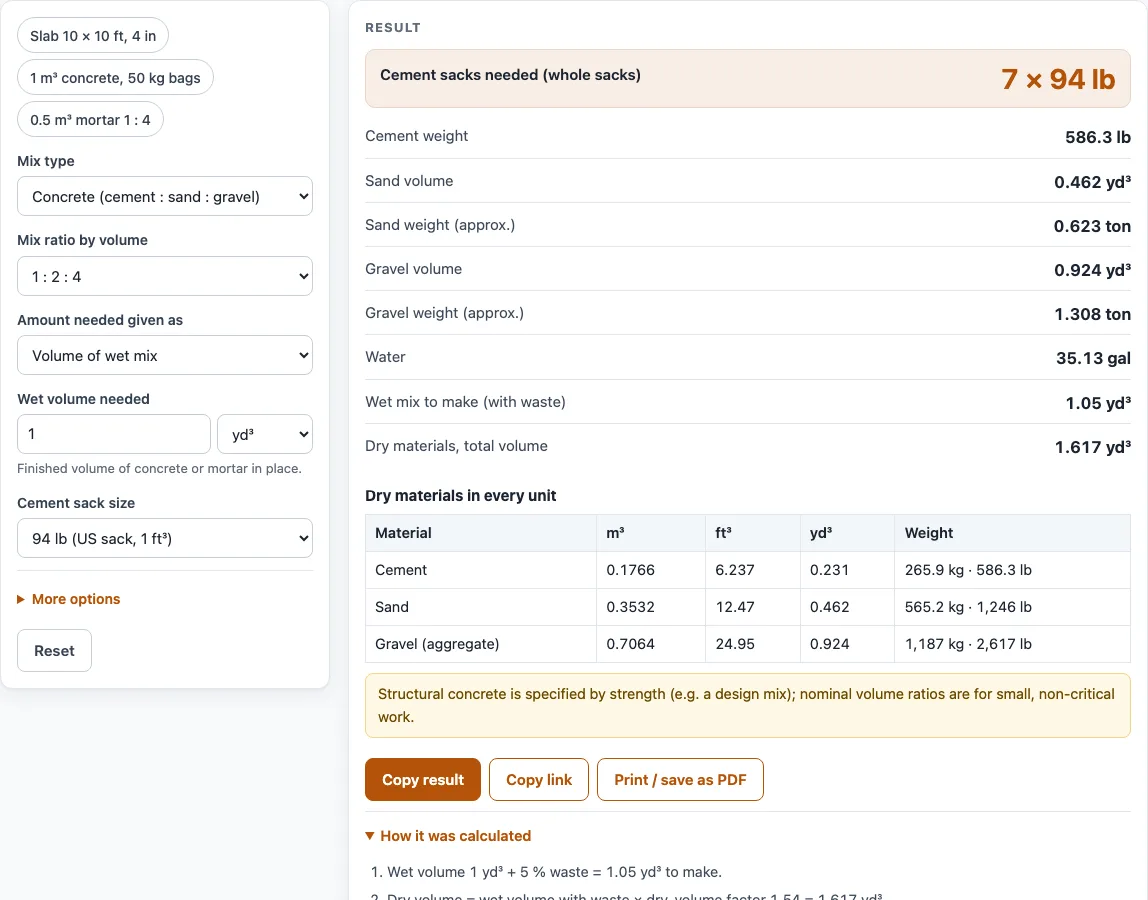
How to use the cement sand mix calculator
- Under Mix type, choose Concrete (cement : sand : gravel) or Mortar (cement : sand).
- Under Mix ratio by volume, pick a ratio from the list. For concrete, the options are 1 : 2 : 4, 1 : 1.5 : 3 and 1 : 3 : 6. For mortar, the options are 1 : 3, 1 : 4, 1 : 5 and 1 : 6. To use your own mix, choose Custom ratio and type the parts into Cement parts, Sand parts and Gravel (aggregate) parts.
- Under Amount needed given as, choose Volume of wet mix and type a value into Wet volume needed, or choose Length × width × thickness and fill in Length, Width and Thickness / depth.
- Under Cement sack size, select the bag you plan to buy: 94 lb, 50 kg, 42.5 kg or 25 kg.
- Open More options if you need to change the Waste / extra (%), the Water-cement ratio (by weight) or the Dry-volume factor (optional). Leave the dry-volume factor empty to use the standard value.
- Read the result rows: cement sacks, cement weight, sand volume and weight, gravel volume and weight, water, wet mix to make, and dry materials total.
- Open How it was calculated to check each step with your own numbers.
The Example buttons above the form fill in common jobs, and Reset restores the example values. Copy link saves every input in the page address, so the same calculation reopens later. Copy result copies the result lines, and Print / save as PDF prints the inputs, results, steps and date.
What does a 1:2:4 concrete mix ratio mean?
A 1:2:4 mix ratio means 1 part cement, 2 parts sand and 4 parts coarse aggregate, measured by volume. Any measure works, such as a bucket or a shovel, as long as every part uses the same one. The total is 7 parts, and the cement is 1 of those 7.
The ratio describes the dry materials before water is added. When the cement, sand and gravel are mixed with water, the materials fill the gaps between each other, so the wet concrete takes up less space than the dry materials did. The tool allows for this by multiplying the wet volume by a dry-volume factor. The tool pre-fills 1.54 for concrete and 1.33 for mortar, the factors used in site estimating; they are conventions rather than values from a standard, so change the factor under More options if your method uses another one. The same goes for the 1,440 kg/m³ loose bulk density used for metric cement bags and the 1 ft³ taken for a 94 lb US sack.
Nominal ratios like this are meant for small, non-critical work. Structural concrete is specified by strength in a design mix, so use the ratio only where a designer or local rules allow it.
How many bags of cement are in a cubic yard of 1:2:4 concrete?
About 7 bags of 94 lb cement, based on the tool’s default calculation for 1 yd³ of 1:2:4 concrete with 5 % waste. The steps behind that figure are below.
- Wet volume with waste: 1 yd³ + 5 % = 1.05 yd³.
- Dry volume: 1.05 yd³ × 1.54 = 1.617 yd³.
- Each part: 1.617 yd³ ÷ 7 = 0.231 yd³.
- Cement: 1 part = 0.231 yd³, which is 6.237 ft³ or about 586.3 lb.
- Sacks: 6.237 ft³ ÷ 1 ft³ per sack = 6.237, rounded up to 7 whole sacks.
The same batch needs about 0.462 yd³ of sand and 0.924 yd³ of gravel. Water is 0.5 × the cement weight, which is 133 L (35.13 US gal). Wet sand already holds some water, so you may need less water on the day.
Worked examples
| Input | Result |
|---|---|
| Concrete (cement : sand : gravel), 1 : 2 : 4, 1 yd³ | 7 sacks of cement, 0.462 yd³ of sand |
| Concrete (cement : sand : gravel), 1 : 2 : 4, 12 ft × 10 ft × 4 in | 10 sacks of cement, 0.6844 yd³ of sand |
| Concrete (cement : sand : gravel), 1 : 2 : 4, 1 m³ | 7 sacks of cement, 0.462 m³ of sand |
| Mortar (cement : sand), 1 : 4, 0.5 m³ | 9 sacks of cement, 0.5586 m³ of sand |
| Concrete (cement : sand : gravel), 1 : 3 : 6, 6 m × 3 m × 100 mm | 9 sacks of cement, 0.8732 m³ of sand |
Calculated by the tool above with these values.
Frequently asked questions
Is the calculator free, and is anything I type uploaded?
Yes, the calculator is free and needs no sign-up. It runs entirely in your browser, and nothing you type is uploaded.
Can I use the results in commercial work such as quotes and bids?
Yes. You can use the results in any work, including estimates, quotes, bids, takeoffs and material orders, and no attribution is needed. Confirm final quantities with your supplier or contractor before you order, because real materials vary in density and moisture.
What does a 1:2:4 mix mean?
It means 1 part cement, 2 parts sand and 4 parts coarse aggregate by volume, which gives 7 parts in total. The wet concrete is smaller than the dry materials, so the calculator multiplies the wet volume by a dry-volume factor.
How many bags of cement are in a cubic yard of 1:2:4 concrete?
The default calculation gives about 7 bags of 94 lb cement per cubic yard, with 5 % waste added. The calculator shows the full steps under How it was calculated if you change the waste, the ratio or the bag size.
Why are my results in cubic yards when I typed meters?
The results use the unit system of the volume or length you type. Feet, inches, and yards give cubic yards, pounds, short tons, and gallons, while meters, centimeters, and millimeters give cubic meters, kilograms, tonnes, and liters. The “Dry materials in every unit” table lists the volumes in m³, ft³, and yd³.
Can I use this for structural concrete?
Not as a design. Structural concrete is specified by strength, and nominal volume ratios are for small, non-critical work. The calculator shows this reminder as a warning whenever the mix type is concrete, and the results are estimates for ordering, not engineering designs or code checks.
Related tools
- Concrete calculator — use it for a general concrete volume estimate before you choose a mix.
- Concrete slab calculator — use it when you are planning a slab and need the volume from its dimensions.
- Concrete bag calculator — use it to work out how many premixed bags a job needs.
- Concrete footing calculator — use it to estimate concrete for footings.
- Concrete step calculator — use it to estimate concrete for steps.
- Sonotube calculator — use it to estimate concrete for cylindrical forms such as sonotubes.
- Concrete weight calculator — use it to find the weight of a concrete volume for delivery or lifting planning.
- All calculators — use it to browse every calculator on the site.
Sources
- Caterpillar, Material Density Tables to Help Estimate Earthwork Volumes: loose densities of gravel, sand, crushed stone, topsoil, loam and clay