Concrete Bags Calculator
Type the size of the pour or its volume and see how many bags of premixed concrete each bag size needs.
The concrete bag calculator works out how many bags of premix concrete a job needs. Enter the length, width and depth of a pour, or a volume you already know, choose a bag size, and it shows the bag count rounded up, the total weight of the bags, and the concrete needed with waste. It runs in your browser, is free, and needs no sign-up.
If you searched for a concrete bag calc, a sack concrete calculator, or concrete calculator bags of cement, the answer you want is how many bags to buy. This page gives that number for 80 lb, 60 lb, 50 lb, 40 lb, 30 kg, 25 kg and 20 kg bags, in US or metric units. The result is an estimate for planning and ordering, so confirm the final count with your supplier.
How to use the concrete bag calculator
- Open the “Work out bags from” menu and choose “Length, width and depth” or “A volume I already know”.
- For length, width and depth, type each measurement and pick its unit: ft, in, yd, m, cm or mm. Take the depth from your plans or local code.
- If you chose “A volume I already know”, type the amount and pick ft³, yd³, m³ or L.
- Open “Bag size” and choose a bag, such as 80 lb (0.60 ft³) or 25 kg. To see every size side by side, choose “Compare all bag sizes”.
- Open “More options” and enter a figure in “Waste / extra (%)”. Use 10 for hand-mixed jobs, or 0 for an exact count.
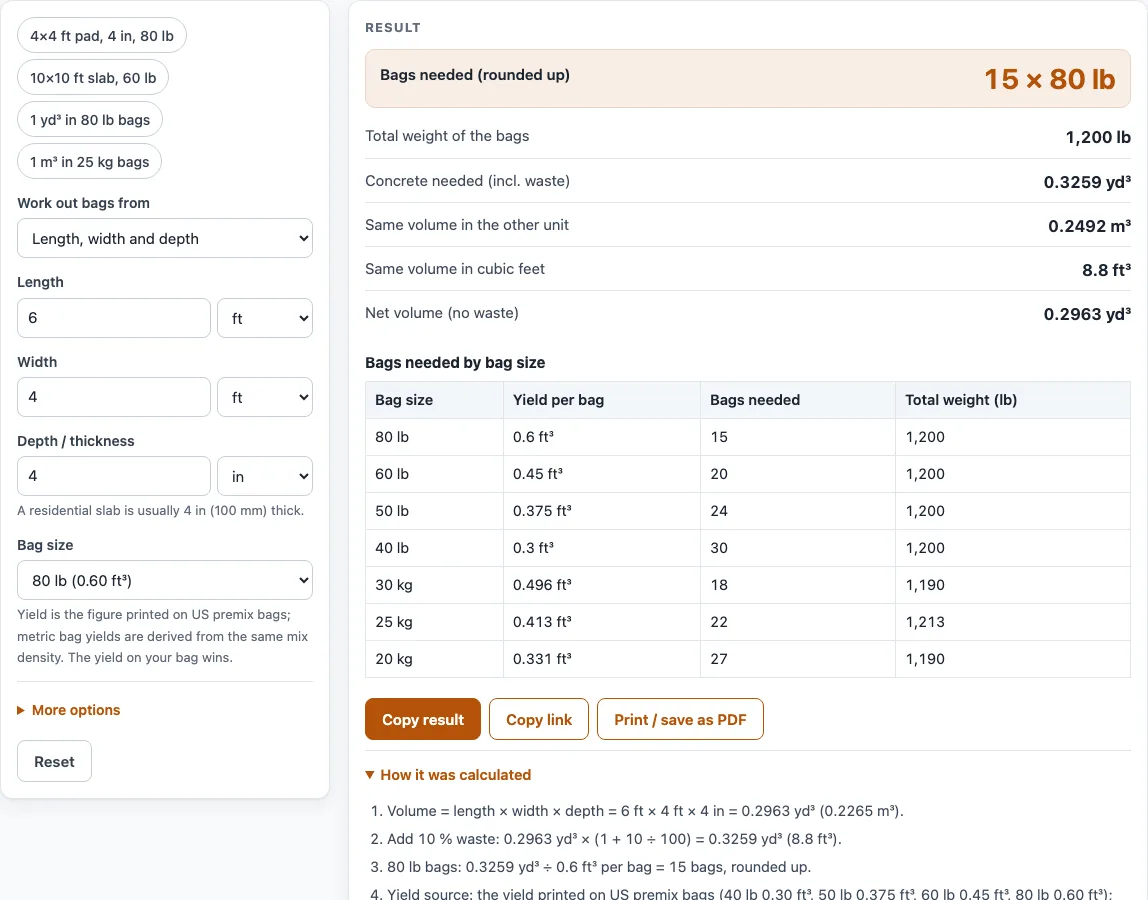
- Read “Bags needed (rounded up)”, “Total weight of the bags” and “Concrete needed (incl. waste)”. Open “How it was calculated” to check each step with your own numbers.
Example buttons above the form fill in common jobs, such as a 4×4 ft pad or a 10×10 ft slab. “Reset” restores the example values. Under the result, “Copy result” copies the result lines and the link, “Copy link” copies a page address that reopens the same inputs, and “Print / save as PDF” prints the inputs, results, steps and date.
How many 80 lb bags of concrete do I need?
Divide the volume you need by 0.60 ft³, the yield printed on an 80 lb bag, then round up to the next whole bag. Use a volume that includes your waste allowance, so the count covers spilled mix and uneven ground.
Take a 6 ft × 4 ft × 4 in pad. Convert the depth to feet first: 4 in is 1/3 ft. The volume is 6 × 4 × 1/3 = 8 ft³, or 0.2963 yd³. Adding 10 % waste gives 8.8 ft³ (0.3259 yd³). Then 8.8 ÷ 0.6 = 14.7, which rounds up to 15 bags. Those 15 bags carry 15 × 80 lb = 1,200 lb of dry mix.
How many bags of concrete are in a yard?
One cubic yard holds 27 cubic feet, so the count is 27 divided by the yield of one bag. That gives about 45 bags of 80 lb (27 ÷ 0.6) or 60 bags of 60 lb (27 ÷ 0.45). With 10 % waste, 1 yd³ needs 50 bags of 80 lb, because 1.1 yd³ × 27 = 29.7 ft³, and 29.7 ÷ 0.6 = 49.5, rounded up.
Metric works the same way. One cubic meter equals 1.308 yd³ or 35.31 ft³. The tool derives metric bag yields from a mix density of about 2,136 kg/m³, so a 25 kg bag yields about 0.0117 m³. One cubic meter with 10 % waste therefore needs 94 bags of 25 kg. The yield printed on your bag is more accurate than these figures, so use it if the two differ.
Can I use the results in commercial work such as quotes and bids?
Yes. Quantities, steps and printouts may be used in any work, including estimates, quotes, bids, takeoffs and material orders, and no attribution is needed. The results are still estimates for planning and ordering, not engineering designs or code checks. Bag yields come from the QUIKRETE data sheet and densities from EN 1991-1-1, and real material varies with type, moisture and grading, so confirm the count with your supplier or contractor before you commit.
Is the calculator free, and is anything I type uploaded?
The calculator is free and needs no sign-up. It runs entirely in your browser, and nothing you type is uploaded. Your inputs are kept in the page address, which is how a link from “Copy link” reopens the same calculation.
Worked examples
| Input | Result |
|---|---|
| 6 ft × 4 ft × 4 in | 15 × 80 lb (0.3259 yd³ incl. waste) |
| 10 ft × 10 ft × 4 in | 82 × 60 lb (1.358 yd³ incl. waste) |
| 1 yd³ | 50 × 80 lb (1.1 yd³ incl. waste) |
| 1 m³ | 94 × 25 kg (1.1 m³ incl. waste) |
| 2 m × 1.5 m × 100 mm | 27 × 25 kg (0.315 m³ incl. waste) |
Calculated by the tool above with these values.
Frequently asked questions
Why is the bag count rounded up?
A partial bag is still a bag you have to buy. If the calculation gives 14.7 bags, you need 15. Rounding down would leave the pour short.
What does the waste allowance do?
It adds a percentage to the volume before the bag count is worked out. Enter 10 for hand-mixed jobs with spilled mix or uneven ground, or 0 for an exact count. Values above 30 % trigger a warning that the figure is unusually high.
Why does the tool warn me about ready-mix?
Above about 1 yd³ (0.75 m³), a ready-mix quote is worth comparing, because that many bags is slow to mix by hand. The tool also warns when the bag count is a lot to mix by hand, so compare delivery prices before you commit.
Why do I see metric or US result rows?
Results use the unit system of the first dimension you type. Feet, inches or yards (or a volume in ft³ or yd³) give cubic yards and bag weights in pounds. Meters, centimeters or millimeters (or m³ or L) give cubic meters and bag weights in kilograms. You can mix units between fields.
What does “Net volume (no waste)” show?
It shows the pour volume before the waste allowance is added. Compare it with “Concrete needed (incl. waste)” to see how much extra mix your waste percentage adds.
Can I use bags from a brand such as Sakrete?
Yes. The tool uses the yields printed on the QUIKRETE Concrete Mix (No. 1101) data sheet. The yield printed on the bag you buy wins, so check that figure before ordering. If it differs, divide the volume by the printed yield and round up.
Can I use it for round forms like sonotubes?
The tool takes length, width and depth, or a volume. For round forms, work out the volume with a dedicated calculator, then enter it under “A volume I already know”.
Related tools
- Concrete calculator : use this for a general concrete volume check before you choose a bag size.
- Concrete slab calculator : use this when you are planning a flat slab or pad.
- Concrete footing calculator : use this to size footings before you count bags.
- Concrete step calculator : use this to estimate concrete for steps.
- Sonotube calculator : use this to work out the volume of round sonotube forms.
- Concrete weight calculator : use this to check the weight of concrete you need to move.
- Cement mix calculator : use this if you are mixing cement and sand yourself instead of buying premix bags.
- All calculators : use this to browse every calculator on the site.
Sources
- QUIKRETE Concrete Mix (No. 1101) data sheet: bag yields 0.30 / 0.375 / 0.45 / 0.60 ft³