Concrete Slab Calculator
Enter the slab's length, width and thickness (or its area) to get the concrete volume, bags, a thickened edge and the gravel base.
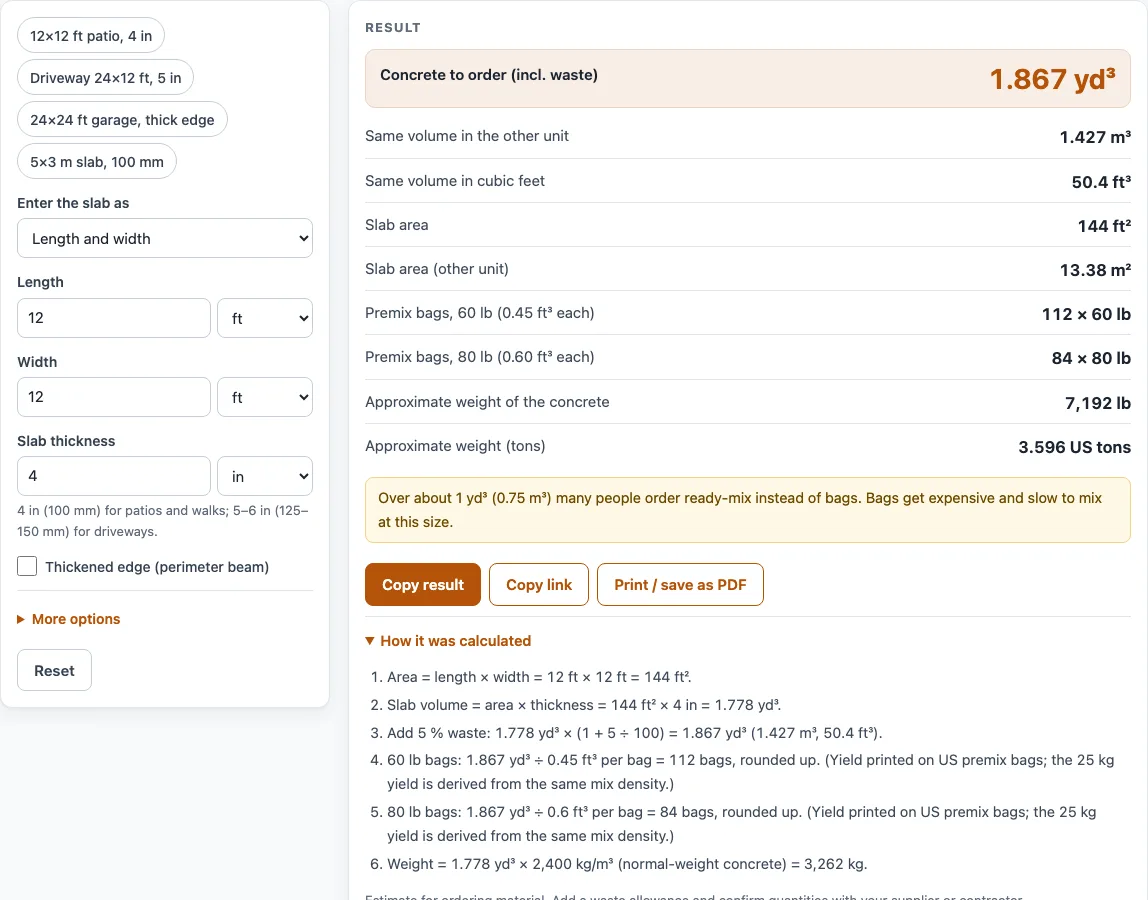
How to use the concrete slab calculator
- Under “Enter the slab as”, choose “Length and width” to type both sides, or “Area (I already know it)” to type the slab area in ft², yd² or m².
- Enter the length and width (or the slab area), and choose a unit for each, such as ft, in, yd, m, cm or mm.
- Enter the “Slab thickness” and its unit. Use 4 in (100 mm) for patios and walks, or 5–6 in (125–150 mm) for driveways.
- If the slab has a thicker border, tick “Thickened edge (perimeter beam)”, then enter the “Edge beam width” (12 in to start) and the “Extra depth below the slab” (8 in to start).
- Open “More options” to change the waste percentage (5 % by default; use 10 % on rough ground). You can also add a “Gravel sub-base depth” or type a “Price per unit of concrete” in yd³ or m³ to get a cost.
- Read the results. “Concrete to order (incl. waste)” is the main figure, followed by bag counts and weight.
- Open “How it was calculated” to see each step with your own numbers.
The example buttons load a patio, a driveway, a garage with a thick edge, and a metric slab. “Reset” restores the defaults. “Copy link” copies an address that holds your inputs. “Copy result” copies the result lines and the link, and “Print / save as PDF” prints inputs, results, steps and the date.
How much concrete do I need for a 10x10 slab?
A 10 ft by 10 ft slab 4 in thick holds 100 ft² × (4 ÷ 12 ft) = 33.3 ft³, which is about 1.23 yd³ (0.94 m³). Adding 5 % waste brings the order to about 1.30 yd³ (0.99 m³). Each cubic yard covers 81 ft² at 4 in thick, so a 100 ft² slab needs a little over one yard before waste is added.
How thick should a concrete slab be?
The right thickness depends on how the slab will be used, and that choice belongs to you or your designer. The tool’s help text suggests 4 in (100 mm) for patios and walks and 5–6 in (125–150 mm) for driveways. If you enter a thickness below the minimum for foot or vehicle traffic, the tool shows a warning. The results are estimates for ordering, not engineering designs, so check local code or ask an engineer for loaded areas.
How does the calculator work out the concrete volume?
The calculator multiplies area by thickness to get volume, then adds the waste percentage. It shows each step: area = length × width, volume = area × thickness, then volume × (1 + waste ÷ 100). Units are converted before the calculation, using 1 yd³ = 27 ft³ = 0.7646 m³ and 1 m³ = 1.308 yd³ = 35.31 ft³.
The weight is found by multiplying the volume in m³ by 2,400 kg/m³, the EN 1991-1-1 Annex A density for normal-weight concrete. For the default example, 1.778 yd³ × 2,400 kg/m³ = 3,262 kg. Real densities vary with mix, moisture and grading, so confirm the figure with your supplier.
How many bags of concrete do I need for a slab?
Divide the volume in cubic feet by the yield of one bag, then round up. The tool uses 0.45 ft³ for a 60 lb bag and 0.60 ft³ for an 80 lb bag. The 25 kg figure is derived from the same mix density. For the default 12 ft × 12 ft × 4 in slab, the total is 1.867 yd³ (50.4 ft³), which needs 112 bags of 60 lb or 84 bags of 80 lb. Above about 1 yd³ (0.75 m³), a ready-mix quote is worth comparing, because that many bags is slow to mix.
Does a thickened edge change the amount of concrete?
Yes. A thickened edge adds a band of extra depth just inside the slab perimeter, and the tool counts it without double-counting the corners. For example, 8 in of extra depth under a 4 in slab gives a 12 in deep edge. A 20 ft × 20 ft slab at 4 in with a thickened edge comes to 7.156 yd³ (5.471 m³) including waste.
Worked examples
| Input | Result |
|---|---|
| 12 ft × 12 ft × 4 in | 1.867 yd³ (1.427 m³); or 112 × 60 lb / 84 × 80 lb bags |
| 24 ft × 12 ft × 5 in | 4.667 yd³ (3.568 m³); or 280 × 60 lb / 210 × 80 lb bags |
| 20 ft × 20 ft × 4 in with thickened edge | 7.156 yd³ (5.471 m³); or 430 × 60 lb / 322 × 80 lb bags |
| 500 ft² × 4 in | 6.481 yd³ (4.955 m³); or 389 × 60 lb / 292 × 80 lb bags |
| 5 m × 3 m × 100 mm | 1.65 m³ (2.158 yd³); or 141 × 25 kg bags |
Calculated by the tool above with these values.
Frequently asked questions
Is the concrete slab calculator free, and is anything I type uploaded?
Yes, the calculator is free, needs no sign-up, and runs entirely in your browser. Nothing you type is uploaded.
Can I use the results in commercial work such as quotes and bids?
Yes. The quantities, steps and printouts can be used in any work, including estimates, quotes, bids, takeoffs and material orders. No attribution is needed.
Can I calculate a circular concrete slab?
The tool has no circle option, but you can use it for a circle. Choose “Area (I already know it)” and type the area, which is π × radius² for a circle. Then enter the thickness as usual.
Can I enter metric measurements?
Yes. Every value can be typed in metric or US units. Results appear in cubic meters and tonnes if you start with meters, cm or mm, and in cubic yards and US tons if you start with feet, inches or yards.
Does the calculator include rebar?
No. The results list concrete, bags, weight, gravel and cost only, so count any reinforcing steel separately.
What does the gravel sub-base result show?
It gives the volume of gravel under the slab based on the depth you enter, for example 4 in (100 mm). It does not include an allowance for compaction, so add one if your base needs it.
How is the concrete slab cost worked out?
The concrete slab cost shown is only as good as the price you type, because the tool has no local prices of its own. Type a price per yd³ or m³ under “More options”, and the tool multiplies it by the concrete volume to give an “Estimated cost” in your price’s currency. Leave the field blank to skip the cost.
Related tools
- Concrete calculator - Use this for general concrete volume when your job is not a flat slab.
- Concrete bag calculator - Use this when you want to count bags for a smaller or mixed job.
- Concrete footing calculator - Use this to estimate concrete for footings below a slab or wall.
- Concrete step calculator - Use this to estimate concrete for a set of steps.
- Sonotube calculator - Use this to estimate concrete for round cylinder forms such as piers.
- Concrete weight calculator - Use this to check the weight of a concrete volume before hauling or lifting.
- Cement mix calculator - Use this to work out cement and sand quantities for a mortar or site mix.
- All calculators - Use this to browse every calculator on the site.
Sources
- QUIKRETE Concrete Mix (No. 1101) data sheet: bag yields 0.30 / 0.375 / 0.45 / 0.60 ft³
- EN 1991-1-1 (Eurocode 1), Annex A Table A.1: normal-weight concrete 24 kN/m³, +1 kN/m³ when reinforced