Concrete Weight Calculator
Enter a volume or the dimensions and the concrete type to get the weight in kg, tonnes, pounds and US tons.
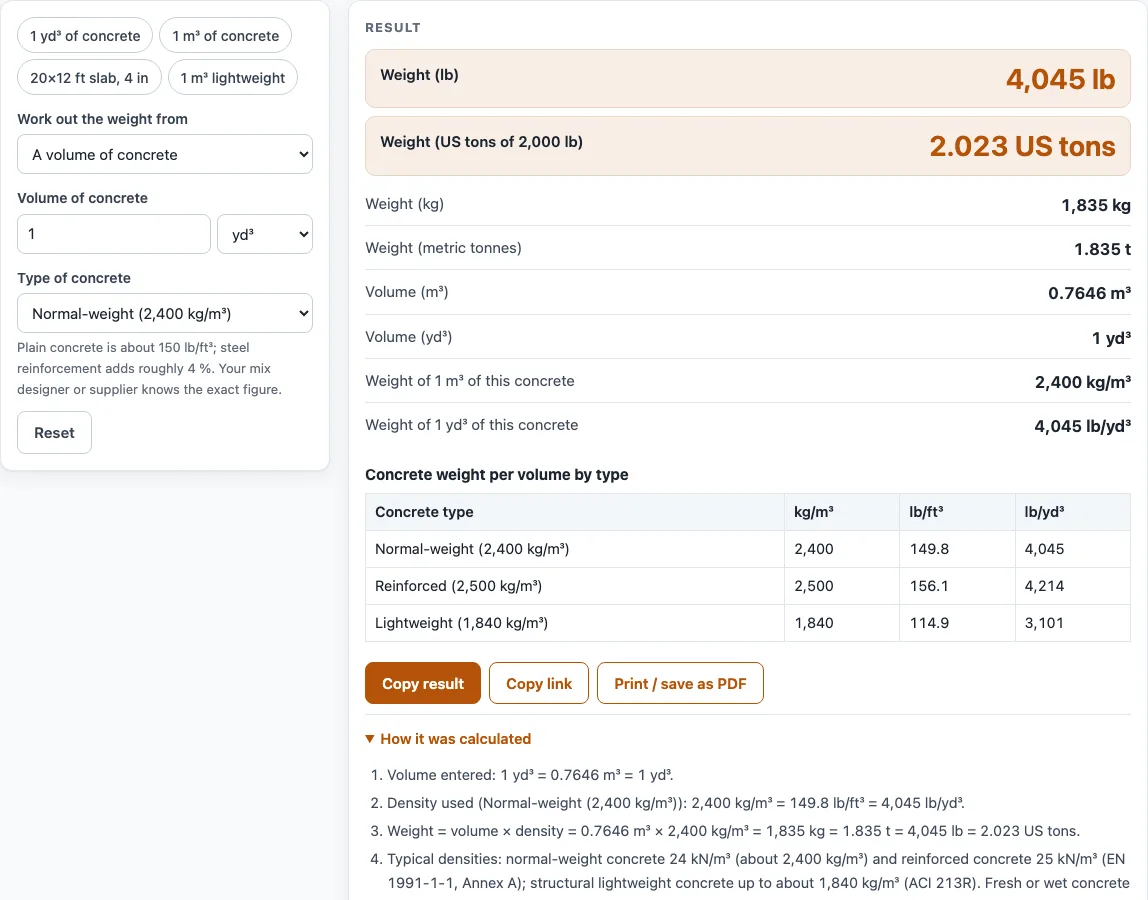
How to use the Concrete Weight Calculator
- Open the “Work out the weight from” menu and choose “A volume of concrete”, “Block or slab (length × width × height)”, or “Cylinder (diameter × height)”.
- For a volume, type the amount in “Volume of concrete” and pick yd³, ft³, m³, or L. For a block or slab, fill in “Length”, “Width”, and “Height / thickness”. For a cylinder, fill in “Diameter” and “Height / thickness”. Each dimension has its own unit menu.
- Open “Type of concrete” and choose Normal-weight (2,400 kg/m³), Reinforced (2,500 kg/m³), Lightweight (1,840 kg/m³), or Custom density.
- For Custom density, type the figure in “Density” and pick kg/m³, lb/ft³, lb/yd³, or t/m³.
- Read the results. They list the weight in lb, US tons, kg, and metric tonnes, the volume in m³ and yd³, and the weight of 1 m³ and 1 yd³ of that concrete. The unit system of your first dimension decides which weights come first.
- Open “How it was calculated” to see each step with your own numbers.
The Examples buttons load 1 yd³, 1 m³, a 20×12 ft slab, and 1 m³ of lightweight concrete. “Reset” restores the defaults. “Copy link” copies an address that holds your inputs, “Copy result” copies the result lines, and “Print / save as PDF” prints them with the steps and date.
How much does a cubic yard of concrete weigh?
A cubic yard of normal-weight concrete weighs about 4,045 lb, or about 2.02 US tons. The calculator multiplies volume by density, since weight equals volume times density.
One cubic yard is 0.7646 m³. At 2,400 kg/m³, that gives 1,835 kg, which is 4,045 lb. As a quick check, plain concrete at 2,400 kg/m³ is about 150 lb/ft³, and a cubic yard holds 27 cubic feet, so 27 × 150 is roughly 4,050 lb. For a concrete weight per cubic foot calculation, enter 1 ft³: the tool returns about 150 lb.
What is the weight of 1 m³ of concrete in kg?
One cubic meter of normal-weight concrete weighs about 2,400 kg, or 2.4 tonnes. Reinforced concrete is taken as 2,500 kg/m³, so one cubic meter weighs about 2,500 kg. Structural lightweight concrete is taken as about 1,840 kg/m³. The results also show “Weight of 1 m³ of this concrete” for your chosen type.
These are reference values. EN 1991-1-1 Annex A gives 24 kN/m³ for normal-weight concrete and 25 kN/m³ for reinforced concrete, and the PCA lightweight concrete fact sheet gives about 1,840 kg/m³ as the upper limit for structural lightweight concrete. Real mixes vary with aggregate, moisture, and grading, and fresh concrete can weigh slightly more. The extra 1 kN/m³ for reinforcement is about 4 % more, which is why the reinforced option is set higher than the normal-weight option.
How much does a concrete slab weigh?
Choose “Block or slab” and enter the sizes. A 20 ft × 12 ft slab that is 4 in thick holds 80 ft³ (2.96 yd³), and in normal-weight concrete it weighs about 11,986 lb, or 5.99 US tons (5,437 kg). A 10 ft × 10 ft slab at 4 in in reinforced concrete weighs about 5,202 lb (2,360 kg). A cylinder 300 mm in diameter and 2.4 m high, in reinforced concrete, weighs about 424 kg.
The weight of the concrete is not the full load on a support. Forms, reinforcement, and live loads add to it, and the tool does not check whether a structure can carry the load.
Conversion factors used by the tool: 1 m³ = 1.308 yd³ = 35.31 ft³; 1 US ton = 2,000 lb; 1 metric tonne = 1,000 kg (2,204.6 lb).
Worked examples
| Input | Result |
|---|---|
| 1 yd³, Normal-weight (2,400 kg/m³) | 4,045 lb (2.023 US tons) |
| 1 m³, Normal-weight (2,400 kg/m³) | 2,400 kg (2.4 t) |
| 20 ft × 12 ft × 4 in, Normal-weight (2,400 kg/m³) | 11,990 lb (5.993 US tons) |
| Ø 300 mm × 2.4 m, Reinforced (2,500 kg/m³) | 424.1 kg (0.4241 t) |
| 1 m³, Lightweight (1,840 kg/m³) | 1,840 kg (1.84 t) |
Calculated by the tool above with these values.
Frequently asked questions
Is the calculator free, and is anything I type uploaded?
Yes, it is free. It runs entirely in your browser, needs no sign-up, and nothing you type is uploaded.
Can I use the results in commercial work such as quotes and bids?
Yes. Quantities, steps, and printouts can be used in any work, including estimates, quotes, bids, takeoffs, and material orders. No attribution is needed.
Why does my supplier’s weight differ from the result?
The densities in the tool are reference values, and real material varies with type, moisture, and grading. Choose Custom density and enter the figure from your mix designer or supplier to match your concrete.
What does the density warning mean?
The tool warns when the density is outside about 500–3,500 kg/m³, the range of concrete. Check both the number and its unit. For example, 2,300 lb/ft³ would be far outside that range, so the warning catches this kind of mistake.
Does the weight include rebar or wet concrete?
Only through the density you choose. The Reinforced option uses 2,500 kg/m³, and the tool notes that fresh concrete can weigh slightly more. It does not count forms, gravel, or other materials.
Are the results suitable for structural design?
No. The results are estimates for planning and ordering, not engineering designs or code checks. Verify critical designs against the applicable standard.
Related tools
- Concrete calculator - use it to work out the volume of concrete a project needs before you calculate its weight.
- Concrete slab calculator - use it to find the volume of a slab from its area and thickness.
- Concrete bag calculator - use it to estimate how many bags of premixed concrete a job needs.
- Concrete footing calculator - use it to size a footing and find how much concrete it takes.
- Concrete step calculator - use it to estimate the concrete needed for a set of steps.
- Sonotube calculator - use it to find the concrete volume for round cardboard forms.
- Cement mix calculator - use it to work out the cement and sand quantities for a mix.
- All calculators - use it to browse every calculator on the site.
Sources
- EN 1991-1-1 (Eurocode 1), Annex A Table A.1: normal-weight concrete 24 kN/m³, +1 kN/m³ when reinforced
- PCA, Structural Lightweight Concrete: 90–115 lb/ft³ (1,440–1,840 kg/m³)