How Many Cubic Yards in a Dump Truck?
Work out the cubic yards and tons one dump truck load carries from the body size, then how many loads your job needs.
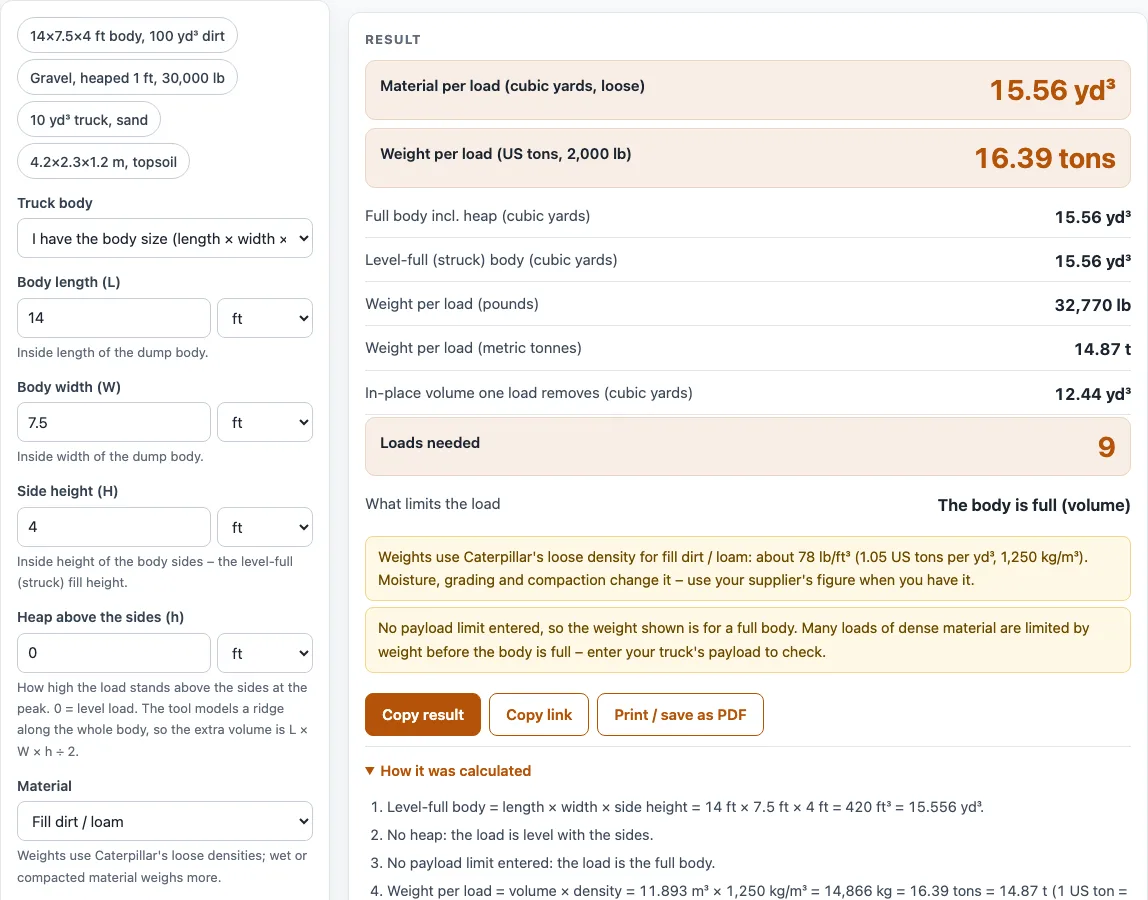
How to use the dump truck capacity calculator
- Under Truck body, choose “I have the body size (length × width × side height)”, or “I know the rated capacity (yd³ or m³)” if the truck’s data plate or spec sheet gives one.
- For a body size, type Body length (L), Body width (W) and Side height (H) as inside measurements and pick a unit for each.
- In Heap above the sides (h), type how high the load stands above the sides at its peak. Leave it at 0 for a level load.
- Choose the Material: gravel, crushed stone, pea gravel, sand, topsoil, fill dirt or clay.
- Optional: type a Payload limit (optional), the legal gross weight minus the empty truck weight. If a full body would weigh more, the load is cut to the payload.
- Optional: type the Job volume (optional) and say whether it is measured “In place” or “Loose”. For in-place soil, the Swell when dug (%) field sets how much it grows once dug.
- Read Material per load, Weight per load, What limits the load and Loads needed, and check any warning shown above them.
The example buttons above the form fill in sample jobs, such as “10 yd³ truck, sand”. Copy result copies the result lines with a link, Copy link reopens your exact inputs later, Print / save as PDF prints the inputs, results, steps and date, and Reset restores the defaults.
How many cubic yards are in a dump truck?
A dump truck holds as many cubic yards as its body is big: length × width × side height, divided by 27 cubic feet per cubic yard. For a body 14 ft long, 7.5 ft wide and 4 ft high, that is 14 × 7.5 × 4 = 420 ft³, and 420 ÷ 27 = 15.56 yd³ when the load is level with the sides. If you measure in inches, multiply length × width × height and divide by 46,656.
Dump trucks come in many sizes, so no single number is right for every truck. Hauler and rental listings commonly quote about 10 to 16 cubic yards for a tandem-axle dump truck. This calculator does not assume that range: it uses the body you enter, or the capacity printed on your truck’s data plate or spec sheet. A hauler can also tell you the load they will really deliver.
How many yards does a dump truck hold when the load is heaped?
A heaped load holds more than a level one. The tool models the heap as a ridge along the whole body, so the extra volume is length × width × peak height ÷ 2. Heaping the example body 1 ft above the sides adds 14 × 7.5 × 1 ÷ 2 = 52.5 ft³, or 1.94 yd³, for 17.5 yd³ in all. Loose material rarely stands steeper than 2 : 1 (2 ft across for every 1 ft of height), so the tool warns when the heap is higher than a quarter of the body width.
How many tons can a dump truck hold?
The weight of a load is its volume × the density of the material, and the truck’s payload limit often stops the load before the body is full. The payload is the legal gross weight minus the empty weight of the truck. On the Interstate System the federal limits are 80,000 lb gross, 20,000 lb on a single axle and 34,000 lb on a tandem axle (23 CFR 658.17), and states or the Bridge Formula can set lower limits, so use your own truck’s rating.
The tool shows both effects. The default 14 × 7.5 × 4 ft body, full of loose materials, weighs about this:
| Material | Full level body, yd³ | Weight, US tons |
|---|---|---|
| Topsoil | 15.56 | 12.45 |
| Fill dirt / loam | 15.56 | 16.39 |
| Sand | 15.56 | 18.62 |
| Gravel | 15.56 | 19.80 |
| Crushed stone | 15.56 | 20.98 |
| Clay | 15.56 | 21.76 |
Densities are Caterpillar’s loose figures, so wet or compacted material weighs more. With a payload of 30,000 lb (15 tons) and the same body heaped 1 ft with gravel, the load is cut from 17.5 yd³ to 11.79 yd³, because 15 tons is all the truck may carry. The result then reads “The payload limit (weight)” under What limits the load.
How many yards of dirt in a dump truck, and how many loads do I need?
Dirt in the ground takes less room than dirt in a truck. When it is dug it swells; the standard soil conversion table gives common earth 1.00 in place and 1.25 loose, so the tool defaults to 25 % swell (change it for your soil). For 100 yd³ of dirt measured in place, the tool hauls 100 × 1.25 = 125 yd³ loose. At 15.56 yd³ per load that is 125 ÷ 15.56 = 8.04, rounded up to 9 loads, because a part load is still a trip. The result also shows the in-place volume one load removes, 12.44 yd³ here.
If your quantity is already loose, such as gravel from a yard, choose “Loose” and no swell is added. For 200 yd³ of loose gravel at 11.79 yd³ per payload-limited load, you need 17 loads. To find the yards of fill for an area and depth first, use the dirt calculator.
Worked examples
| Input | Result |
|---|---|
| a 14 ft × 7.5 ft × 4 ft body, fill dirt / loam | 15.56 yd³ (16.39 tons); 9 load(s) for 100 yd³ |
| a 14 ft × 7.5 ft × 4 ft body, gravel | 11.79 yd³ (15 tons); 17 load(s) for 200 yd³ |
| a 10 yd³ body, sand | 10 yd³ (11.97 tons); 5 load(s) for 50 yd³ |
| a 4.2 m × 2.3 m × 1.2 m body, topsoil | 12.56 m³ (11.93 t); 8 load(s) for 80 m³ |
| a 16 yd³ body, clay | 8.577 yd³ (12 tons); 19 load(s) for 120 yd³ |
Calculated by the tool above with these values.
Frequently asked questions
How many yards are in a dump truck?
It depends on the body. Multiply its inside length, width and side height in feet and divide by 27 to get cubic yards. The example body, 14 × 7.5 × 4 ft, holds 15.56 yd³ level-full. Commonly quoted listings range from about 10 to 16 cubic yards for a tandem-axle truck, but your own truck’s rating is what counts.
Is a dump truck’s capacity in yards the same as the yards of dirt it can carry?
Not always. The body fills first only for light material. For dense material such as wet clay, gravel or crushed stone, the payload limit is usually reached before the body is full, and the tool cuts the load to match when you enter a payload.
What is the difference between struck and heaped capacity?
Struck capacity is the volume level with the sides of the body. Heaped capacity adds the material piled above the sides. The tool lets you set the heap height, and it models the pile as a ridge along the body, so the load changes only by L × W × h ÷ 2.
Why does the load in tons change with the material?
Tons are the volume multiplied by the density of what you carry. The same 15.56 yd³ body weighs about 12.45 tons with topsoil and about 21.76 tons with clay. Pick the closest material, or ask your supplier for the tons per cubic yard of the actual load.
Is the calculator free, and is anything I type uploaded?
Yes, the calculator is free, needs no sign-up, and runs entirely in your browser. Nothing you type is uploaded.
Can I use the results in commercial work such as quotes and bids?
Yes. Results, steps and printouts may be used in any work, including estimates, quotes, bids, takeoffs and material orders, and no attribution is needed. Each result still reads as an estimate, so confirm the load and the legal weight with your hauler.
Can I enter measurements in metric units?
Yes. Every value can be typed in meters, centimeters, cubic meters, kilograms or tonnes, and the tool converts them before calculating. Results then appear in m³ and tonnes when your body size or rated capacity is metric.
Related tools
- Dirt calculator: use this when you have an area and a depth and want the fill dirt in yards, tons and truckloads.
- Cubic yards to tons calculator: use this when you already have a volume and need its weight for a given material.
- Cut and fill calculator: use this when you are moving soil on a graded site and need the cut, fill and swell.
- Cubic yard calculator: use this to turn any shape into cubic yards before you order.
- Gravel calculator: use this when the load is crushed stone or gravel for a base.
- All calculators: use this when you want to browse every tool on the site.
Sources
- Caterpillar, Material Density Tables to Help Estimate Earthwork Volumes: loose densities of gravel, sand, crushed stone, topsoil, loam and clay
- Standard soil conversion table (common earth: bank 1.00, loose 1.25, compacted 0.90), e.g. Prof. A. S. Hanna’s earthwork notes
- 23 CFR 658.17, Weight (eCFR): federal gross, single-axle and tandem-axle weight limits
- NIST Handbook 44, Appendix C: 1 cubic yard = 27 cubic feet, 1 US ton = 2,000 lb