Roof Pitch and Slope Calculator
Enter rise and run, the span, an angle or a pitch to get the roof pitch in x/12, degrees and percent, and the rafter length.
The Roof pitch calculator is a free tool that works out a roof’s slope from its rise and run, span and rise, angle, or pitch, and shows the pitch, angle, slope percentage, ratio, and, when a run is known, the rafter length. It runs entirely in your browser, needs no sign-up, and nothing you type is uploaded.
Use it to check a roof’s slope before you order materials, compare a roof angle with a pitch such as 6/12, or estimate how long the rafters will be. It works in metric or US units, and you can mix them. Every result is an estimate for planning and ordering, so confirm quantities and roofing requirements with your supplier or contractor.
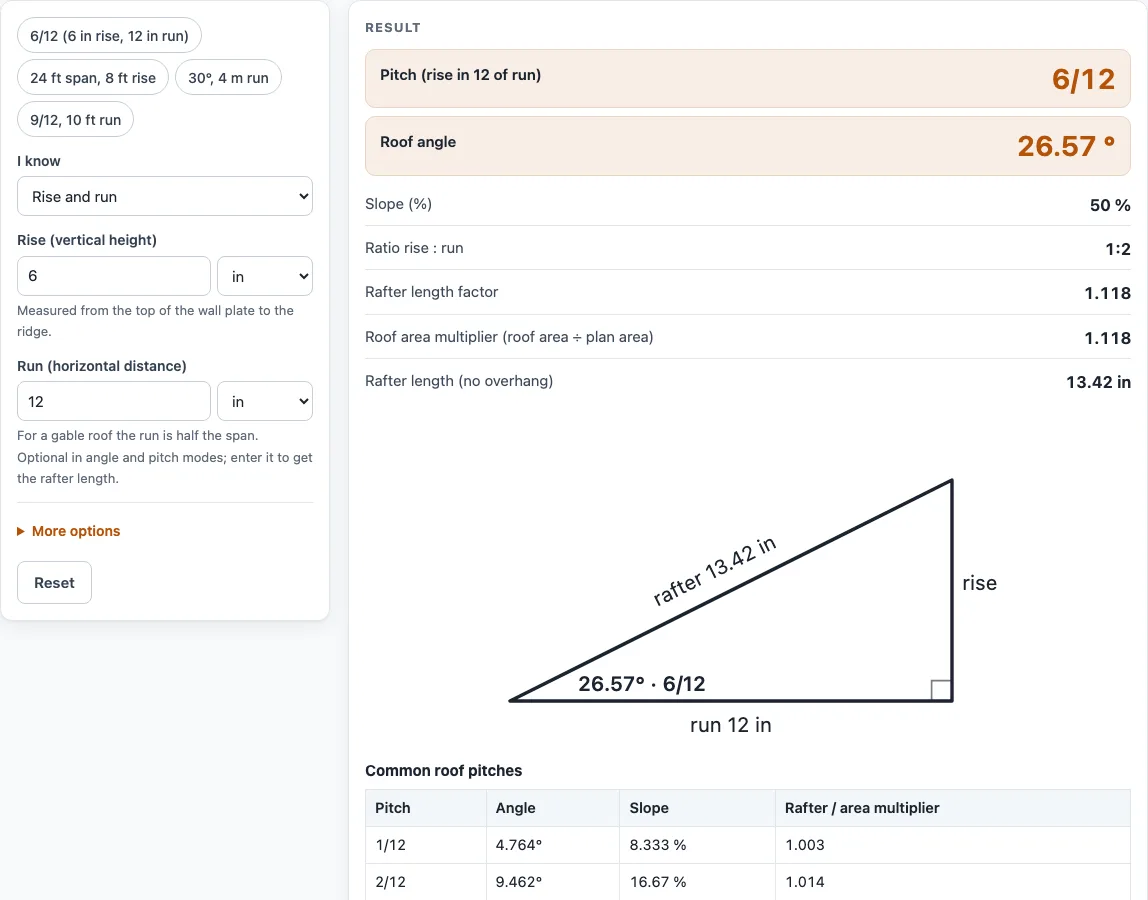
How to use the Roof pitch calculator
- Open the I know menu and choose the measurement you have: Rise and run, Roof angle (degrees), Pitch (x in 12), or Span and rise (gable roof).
- Enter the values for that choice. For Rise and run, fill in Rise (vertical height) and Run (horizontal distance). For Span and rise, fill in Span (building width, wall to wall) and Rise (vertical height). For angle or pitch, type the value in Roof angle (°) or Pitch: rise per 12 of run.
- Pick the unit for each box: in, ft, mm, cm or m.
- To get rafter length in angle or pitch mode, enter a value in Run (horizontal distance). For a gable roof, the run is half the span.
- To add an overhang, open More options and enter Eave overhang (horizontal). The rafter length with overhang is then shown.
- Read the result rows and check any warning. The calculator warns you about pitches below 2/12 and angles above 60°.
- Open How it was calculated to see each formula step with your own numbers.
Click an example button above the form, such as 6/12 or 30°, to see a sample calculation. Reset restores the example values. Copy link copies a page address that reopens the same inputs. Copy result copies the result lines with a link, and Print / save as PDF prints your inputs, results, steps and the date.
How do you find the pitch of a roof?
Roof pitch is the rise of a roof for every 12 units of horizontal run, written as x/12. To find it, divide the rise by the run, then multiply by 12. A rise of 6 in over a run of 12 in gives a slope of 0.5, and 0.5 × 12 = 6, so the pitch is 6/12.
The same method works in any unit, as long as rise and run use the same one. A roof that rises 1.5 m over 4 m of run has a slope of 0.375, which is a pitch of 4.5/12.
How do you convert roof pitch to degrees?
Take the arctangent of the slope, which is rise divided by run. A 6/12 pitch has a slope of 0.5, and arctan(0.5) is 26.57°. Going the other way, multiply the tangent of the angle by 12 to get the pitch.
| Pitch | Angle | Slope (%) |
|---|---|---|
| 2/12 | 9.46° | 16.67 % |
| 3/12 | 14.04° | 25 % |
| 5° roof | 5° (about 1.05/12) | 8.75 % |
| 6/12 | 26.57° | 50 % |
| 9/12 | 36.87° | 75 % |
| 10/12 | 39.81° | 83.33 % |
What is a roof gradient, and how is slope percent found?
A roof gradient is another way of describing how steeply a roof slopes. It is usually given as a percentage: slope % = rise ÷ run × 100. A 6/12 roof has a slope of 50 %, meaning it rises half a unit for every unit of run.
How is rafter length worked out from the pitch?
The rafter length factor is √(rise² + run²) ÷ run, which is the same as √(1 + slope²). Multiply the run by this factor to get the rafter length. For a 6/12 roof with a 12 in run, 12 in × 1.118 = 13.416 in. Eave overhang is added on top of this length.
The same factor turns plan area into roof area. Multiply the floor or footprint area by it to get the sloped roof area.
Do hip, slant, porch and patio roofs use the same rule?
Yes, for any single sloped plane. Measure the rise and run of that plane and apply the same formula, whether the roof is a porch, patio, slant or single slope roof. A hip roof has slopes on several sides, so find the pitch of each face separately.
Worked examples
| Input | Result |
|---|---|
| Rise (vertical height) 6 in, Run (horizontal distance) 12 in | pitch 6/12, 26.57°, rafter factor 1.118 |
| Span (building width, wall to wall) 24 ft, Rise (vertical height) 8 ft | pitch 8/12, 33.69°, rafter factor 1.202 |
| 30° | pitch 6.928/12, 30°, rafter factor 1.155 |
| 9/12 | pitch 9/12, 36.87°, rafter factor 1.25 |
| Rise (vertical height) 1.5 m, Run (horizontal distance) 4 m | pitch 4.5/12, 20.56°, rafter factor 1.068 |
Calculated by the tool above with these values.
Frequently asked questions
Is the calculator free, and is anything I type uploaded?
Yes, the calculator is free and runs entirely in your browser. It needs no sign-up, and nothing you type is uploaded.
Can I use the results in commercial work such as quotes and bids?
Yes. Results, steps and printouts may be used in any work, including estimates, quotes, bids, takeoffs and material orders. No attribution is needed.
What does the “Nearest whole pitch” result mean?
It rounds your roof’s pitch to the closest whole number over 12, such as 6/12 or 9/12, and appears only when the exact pitch is not already a whole number. Use it as a quick label, but keep the exact pitch when you check roofing product limits.
Why does the calculator warn about pitches below 2/12?
Roofs below 2/12 (about 9.5°) are low-slope roofs. Many roofing materials, such as asphalt shingles, are only made for 2/12 and steeper, so check the manufacturer’s minimum.
For a gable roof, what should I enter as the run?
Enter half the span, which is the wall-to-wall building width. Use Span and rise (gable roof) in the I know menu, or enter the half-span in the run box.
Does the calculator check whether my roof is safe or meets building code?
No. Results are estimates for planning and ordering, not engineering designs or code checks. Confirm structural and code requirements with a qualified professional.
Can I mix metric and US units?
Yes. Every value can be typed in metric or US units. The calculator converts them before calculating, so you can enter a rise in inches and a run in meters.
Related tools
- Rise over run calculator: use it when you want the slope of a surface as a percentage from rise and run.
- Cut and fill calculator: use it to estimate earth to remove or add when grading a sloped site.
- Concrete step calculator: use it to plan the rise and run of concrete steps.
- All calculators: browse every calculator on the site.
Sources
- OpenStax Precalculus, right-triangle trigonometry: slope, angle and pitch