Sand Calculator
Enter the area and depth, choose dry or damp sand, and get the volume, the weight in tons and the number of bags.
A sand calculator works out how much sand to order for an area, in cubic yards or cubic meters, in US tons or metric tonnes, and in bags. It suits a sandbox, a volleyball court, a base under pavers or a slab, fill, a horse arena or a topdressing. You enter the shape and size of the area, the layer depth and whether the sand is dry or damp, and the tool shows the volume to order, the weight, the bags needed and an optional cost.
Sand is sold by volume and by weight, and the two differ by the moisture in the sand, which is why this tool lets you choose dry or damp sand. It runs in your browser, needs no sign-up and uploads nothing. The numbers are planning estimates: confirm the quantity and the tons per yard with your supplier.
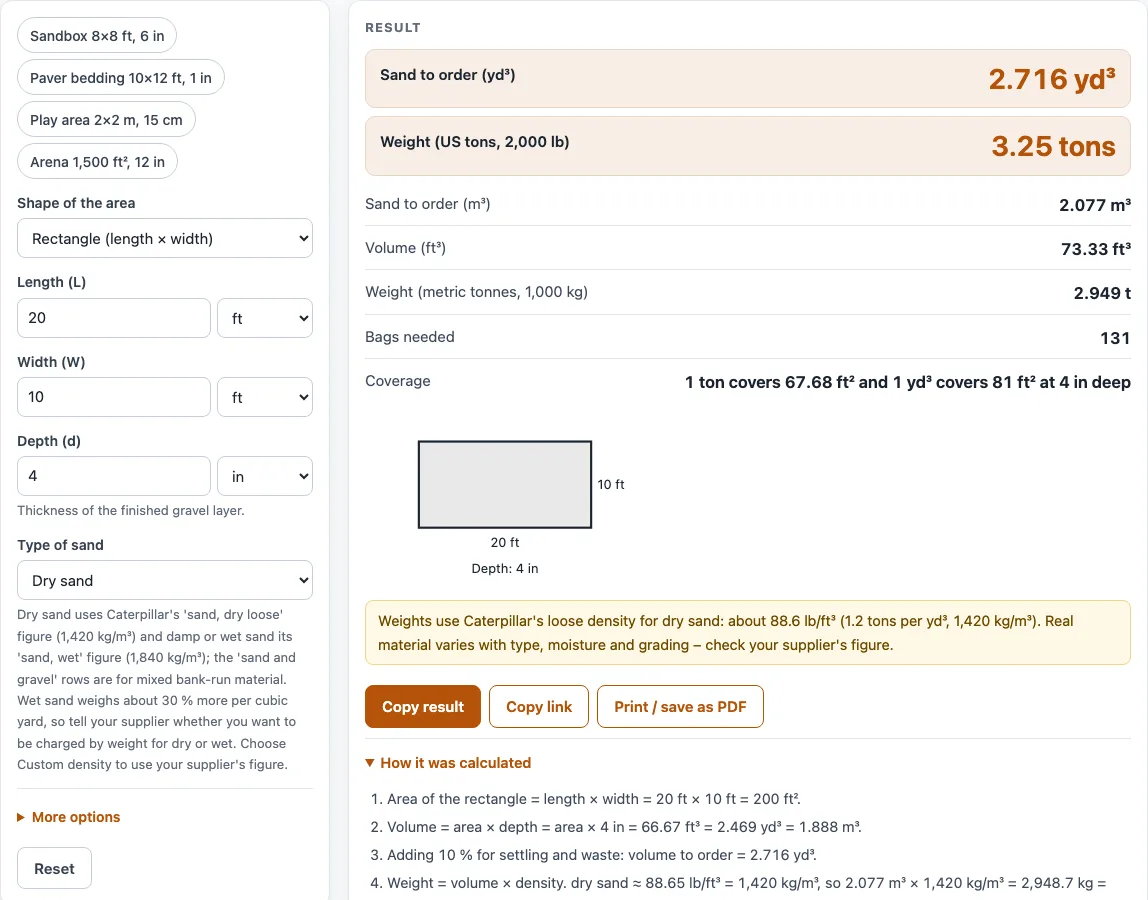
How to use the Sand calculator
- Choose the Shape of the area: Rectangle (length × width), Circle (diameter), Triangle (base × height) or Area already known.
- Fill in the boxes for your shape, each with a unit (ft, in, yd, m, cm or mm). For Area already known, type the area in ft², yd², m², acres or hectares.
- Enter the Depth (d) of the finished layer, not the depth of the pile.
- Choose the Type of sand: Dry sand, Damp / wet sand, or sand and gravel (dry or wet) for mixed bank-run material. For Custom density, type the Bulk density your supplier gives.
- Open More options to change Extra for settling and waste (%), which starts at 10, the Weight of one bag (50 lb to start; use the weight printed on your bag), and an optional Price per US ton, tonne, cubic yard or cubic meter.
- Read the results and open How it was calculated to check each step.
The example buttons (Sandbox 8×8 ft, Paver bedding 10×12 ft, Play area 2×2 m, Arena 1,500 ft²) load a complete calculation you can change. Reset restores the defaults, Copy link saves every input in the page address and Print / save as PDF prints your inputs, results, steps and the date.
How much sand do I need?
Multiply the area by the depth to get the volume, then add a little for settling and waste. For a sandbox 8 ft × 8 ft with 6 in of sand, the area is 64 ft² and the depth is half a foot, so the volume is 32 ft³. With the default 10 % extra, that is 35.2 ft³, or 1.304 cubic yards. One cubic yard is 27 cubic feet, and it covers 324 ft² at 1 in deep, 81 ft² at 4 in and 54 ft² at 6 in. A paver bedding layer of 1 in over 10 ft × 12 ft is 10 ft³ before the 10 % extra.
How many tons of sand are in a cubic yard?
Dry loose sand weighs about 1.2 US tons per cubic yard. The tool uses Caterpillar’s loose density table: dry loose sand is 1,420 kg/m³ (88.65 lb/ft³), and 27 ft³ of it is about 2,394 lb, or 1.2 tons (a US ton is 2,000 lb). The same table gives wet sand 1,840 kg/m³, or about 1.55 tons per cubic yard, so a yard of wet sand weighs about 30 % more than a yard of dry sand. That is why the sandbox above is 1.56 tons dry but about 2.02 tons wet.
Mixed sand and gravel is heavier again: 1,720 kg/m³ dry (about 1.45 tons per yard) and 2,020 kg/m³ wet (about 1.70). If your supplier sells by the ton, ask whether the quoted weight is for the moist sand you will receive and enter their figure as Custom density.
How many bags of sand do I need?
The tool divides the weight to order by the weight of one bag and rounds up. Bags are sold by weight, so use the weight printed on your bag rather than a fixed size. For the 8 ft × 8 ft sandbox at 6 in, with dry sand and 50 lb bags, the tool gives 63 bags. Large areas are cheaper by the ton or the yard than by the bag, so the bag count is mostly useful for small jobs.
Which sand do I use: concrete, mason, fill or play sand?
The type changes the grading and use, not the way you calculate the quantity. Concrete sand and mason sand are used to mix concrete and mortar, fill sand is used under slabs and for levelling, and play sand is washed and screened for sandboxes. All of them are priced by volume or weight, so the calculation is the same: area × depth, then weight from the density. Densities differ a little by grading and moisture, so a supplier’s tons per cubic yard figure under Custom density is the most accurate value. For mixing concrete from sand and cement, use the cement sand mix calculator.
Sources
- Caterpillar loose density table (sand, dry loose 1,420; sand, wet 1,840; sand and gravel dry 1,720, wet 2,020 kg/m³), read October 2026
Worked examples
| Input | Result |
|---|---|
| 8 ft × 8 ft, 6 in deep, dry sand | 1.304 yd³ (0.9968 m³), 1.56 tons |
| 10 ft × 12 ft, 1 in deep, dry sand | 0.4074 yd³ (0.3115 m³), 0.4876 tons |
| 2 m × 2 m, 15 cm deep, damp / wet sand | 0.63 m³ (0.824 yd³), 1.159 t |
| 1,500 ft², 12 in deep, damp / wet sand | 61.11 yd³ (46.72 m³), 94.77 tons |
Calculated by the tool above with these values.
Frequently asked questions
Is the calculator free, and is anything I type uploaded?
Yes, it is free. It runs entirely in your browser, needs no sign-up, and nothing you type is uploaded.
Is a yard of wet sand heavier than dry sand?
Yes. Caterpillar’s table has wet sand at 1,840 kg/m³ against 1,420 kg/m³ for dry loose sand, about 30 % more. A cubic yard is about 1.2 tons dry and about 1.55 tons wet, so a load sold by weight carries more water if it is wet.
How much sand do I need for a sandbox?
An 8 ft × 8 ft sandbox filled to 6 in needs 32 ft³, which is about 1.3 cubic yards with 10 % extra, or about 1.56 US tons of dry sand. Many sandboxes are shallower, so change the depth.
How much sand do I need for a horse arena or volleyball court?
Enter the area and the depth of the footing layer. For 1,500 ft² at 12 in with damp sand and 10 % extra, the tool gives about 61 cubic yards and about 95 tons. Ask your supplier for their tons per yard, because arena sand is graded and moisture changes the weight.
Can I use the results in commercial work such as quotes and bids?
Yes. The quantities, steps and printouts can be used in any work, including estimates, quotes, bids and material orders, and no attribution is needed. Confirm final quantities with your supplier before you order.
Should I always add 10 % extra?
The default is 10 %, a starting value for settling and spillage. Use 0 for the exact volume, or the figure your contractor or supplier suggests.
Related tools
- Gravel calculator: use it for gravel, crushed stone, pea gravel and river rock by area and depth.
- Cement sand mix calculator: use it to work out how much cement and sand a mortar or concrete mix needs.
- Cubic yards to tons calculator: use it to convert a volume of sand into tons.
- Dirt calculator: use it for fill dirt and earthwork.
- Concrete slab calculator: use it when a sand layer sits under a slab.
- All calculators: use it to browse every tool on the site.