Sonotube Calculator (Concrete Cylinder)
Pick the tube diameter, height and number of tubes to get the concrete per tube and in total, in volume and bags.
A Sonotube calculator estimates how much concrete you need to fill round fiber forms. Sonotube is a common brand name for these tubes, so the tool works for any round tube or round hole. Enter the inside diameter, the fill height and the number of tubes, and it returns the volume in cubic yards, cubic feet or cubic meters, the number of premix bags to buy, and the weight of the placed concrete.
It is useful for a concrete cylinder calculator or concrete column calculator job, such as footings, piers and posts. You can enter values in inches and feet or in millimeters and meters. A waste allowance is added so the bag count covers spillage and uneven hole bottoms. The calculator is free, runs in your browser, and needs no sign-up.
How to use the Sonotube calculator
- Choose a Tube diameter from the list, such as 12 in (305 mm). If your size is not listed, select Custom diameter, then enter the value and pick its unit (in, cm, mm, ft or m).
- Enter the Height (depth) of each tube, and choose its unit (ft, in, yd, m, cm or mm). Measure from the bottom of the hole to the top of the pour.
- Enter the Number of tubes.
- Select a Premix bag size: 40 lb, 60 lb, 80 lb, 20 kg or 25 kg. The bag counts use this size.
- Open More options and set the Waste allowance (%). Use 5 % for a standard job, or 10 % for dug holes.
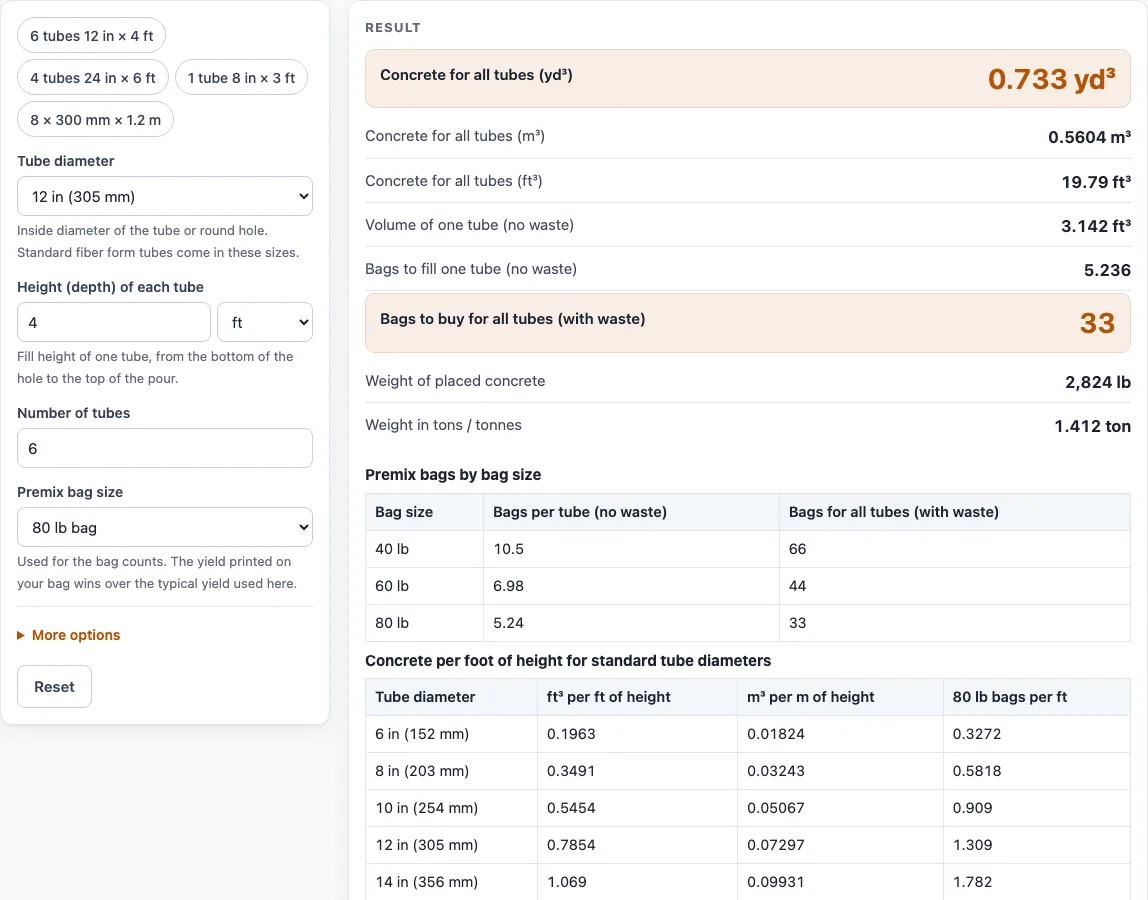
- Read the results: the concrete for all tubes, the volume and bags for one tube, the bags to buy, and the weight. Tables show bag counts by bag size and concrete per foot of height for standard diameters. Then open How it was calculated to see each step with your own numbers.
The four example buttons load 6 tubes at 12 in × 4 ft, 4 tubes at 24 in × 6 ft, 1 tube at 8 in × 3 ft, and a metric job. Reset restores the default values. The yield printed on your bag takes priority over the QUIKRETE data-sheet yield the tool uses.
Under the result, Copy result copies the result lines with a link, and Copy link copies a page address that holds every input, so the same calculation reopens later. Print / save as PDF prints the inputs, results, calculation steps and the date.
Is the calculator free, and is anything I type uploaded?
Yes, the calculator is free and needs no sign-up. It runs entirely in your browser, and nothing you type is uploaded, so you can try different tube sizes and heights as often as you like.
Can I use the results in commercial work such as quotes and bids?
Yes. Results, steps and printouts may be used in any work, including estimates, quotes, bids, takeoffs and material orders, and no attribution is needed. Every figure comes from one rule, the volume of a round column:
Volume = π ÷ 4 × diameter² × height
The tool applies this rule to each tube, multiplies by the number of tubes, and then adds the waste allowance. The default example works like this:
- One tube: 0.7854 × (1 ft)² × 4 ft = 3.142 ft³. The 12 in diameter is 1 ft.
- All six tubes: 6 × 3.142 = 18.85 ft³. Adding 5 % waste gives 19.79 ft³, which is 0.733 yd³ or 0.5604 m³.
- Bags: An 80 lb bag yields 0.60 ft³ (QUIKRETE data sheet). One tube takes 5.236 bags before waste. All tubes with waste need 33 whole bags, because 19.79 ÷ 0.6 = 32.98, rounded up.
- Weight: The weight uses the volume before waste. It is 0.5338 m³ × 2,400 kg/m³, the EN 1991-1-1 figure for normal-weight concrete, which gives 2,824 lb.
Units follow the unit of the Height. Feet, inches or yards give US results (yd³, ft³, lb and US tons, with 40, 60 and 80 lb bags in the table). Meters, centimeters or millimeters give metric results (m³, kg and tonnes, with 20 and 25 kg bags in the table). For reference, 1 yd³ = 27 ft³ = 0.7646 m³, a US ton is 2,000 lb, and a metric tonne is 1,000 kg (2,204.6 lb).
The results are estimates for planning and ordering. They are not engineering designs or code checks. Densities (EN 1991-1-1) and bag yields (QUIKRETE data sheet) are reference values, and real material varies with type, moisture and grading. Confirm quantities with your supplier or contractor before you buy.
Worked examples
| Input | Result |
|---|---|
| 6 tubes, 12 in diameter, 4 ft high | 0.733 yd³ (0.5604 m³) with waste, 33 × 80 lb bags |
| 10 tubes, 8 in diameter, 3 ft high | 0.4072 yd³ (0.3114 m³) with waste, 19 × 80 lb bags |
| 4 tubes, 24 in diameter, 6 ft high | 2.932 yd³ (2.242 m³) with waste, 176 × 60 lb bags |
| 8 tubes, 300 mm diameter, 1.2 m high | 0.9319 yd³ (0.7125 m³) with waste, 61 × 25 kg bags |
| 2 tubes, 36 in diameter, 10 ft high | 5.498 yd³ (4.203 m³) with waste, 248 × 80 lb bags |
Calculated by the tool above with these values.
Frequently asked questions
How much concrete does a 12 inch sonotube hold?
A 12 in tube holds 0.785 ft³ for each foot of height. A 4 ft tall tube therefore holds about 3.14 ft³, or 0.116 yd³, before any waste. Enter your own height in the calculator for an exact figure.
How many bags of concrete per sonotube do I need?
It depends on the bag size and the height of the tube. With the QUIKRETE data-sheet yield, a 12 in × 4 ft tube takes about 5.2 bags of 80 lb premix before waste. Use the yield printed on your bag if it differs.
Does the sonotube weight capacity show how much load a column can carry?
No. The weight result is only the weight of the placed concrete, so you can plan delivery and handling. It does not show load capacity, which needs an engineer’s design.
Do I need to check tube sizes before ordering?
Yes. Fiber form tubes are sold in standard diameters, such as 6, 8, 10, 12, 14, 16, 18, 20, 24, 30 and 36 in. If you select a custom diameter, confirm that your supplier stocks it.
Why does the calculator suggest ready-mix when the bag count is high?
A large number of premix bags means a lot of hand mixing. The tool shows a warning in that case, because a ready-mix delivery quote is worth comparing for a big volume.
Is the waste allowance the same for every job?
No. Five percent is the starting value; raise it for dug holes, where spillage and uneven bottoms are more likely.
Related tools
- Concrete calculator — Use it for general concrete estimates when your project is not built from round forms.
- Concrete slab calculator — Use it to estimate concrete for flat slabs and pads.
- Concrete bag calculator — Use it to count premix bags for any shape of pour.
- Concrete footing calculator — Use it to size strip or pad footings before you pour.
- Concrete step calculator — Use it to estimate concrete for stair treads and risers.
- Concrete weight calculator — Use it to check the weight of a concrete volume for delivery or handling.
- Cement mix calculator — Use it to work out cement, sand and aggregate proportions for a mix.
- All calculators — Use it to browse every calculator on the site.
Sources
- Sonoco Sonotube round forms brochure: diameters 6–36 in
- QUIKRETE Concrete Mix (No. 1101) data sheet: bag yields 0.30 / 0.375 / 0.45 / 0.60 ft³
- EN 1991-1-1 (Eurocode 1), Annex A Table A.1: normal-weight concrete 24 kN/m³, +1 kN/m³ when reinforced