Stone Calculator
Enter the area and depth, choose the stone or aggregate, and get cubic yards, tons and coverage per ton.
A stone calculator works out how much stone to order for an area at a given depth, in cubic yards or cubic meters and in US tons or metric tonnes. It suits driveways, roads, paths, drainage layers, patio bases and landscape beds. You enter the shape and size of the area, the layer depth and the kind of stone or aggregate, and the tool shows the volume to order, the weight, how far one ton goes at that depth and an optional cost.
Stone is delivered by the ton and ordered by the yard, so the page converts between the two with the loose density of the material you choose. It runs entirely in your browser, needs no sign-up and uploads nothing. Treat the numbers as planning estimates and confirm the final quantity and the tons per yard with your supplier.
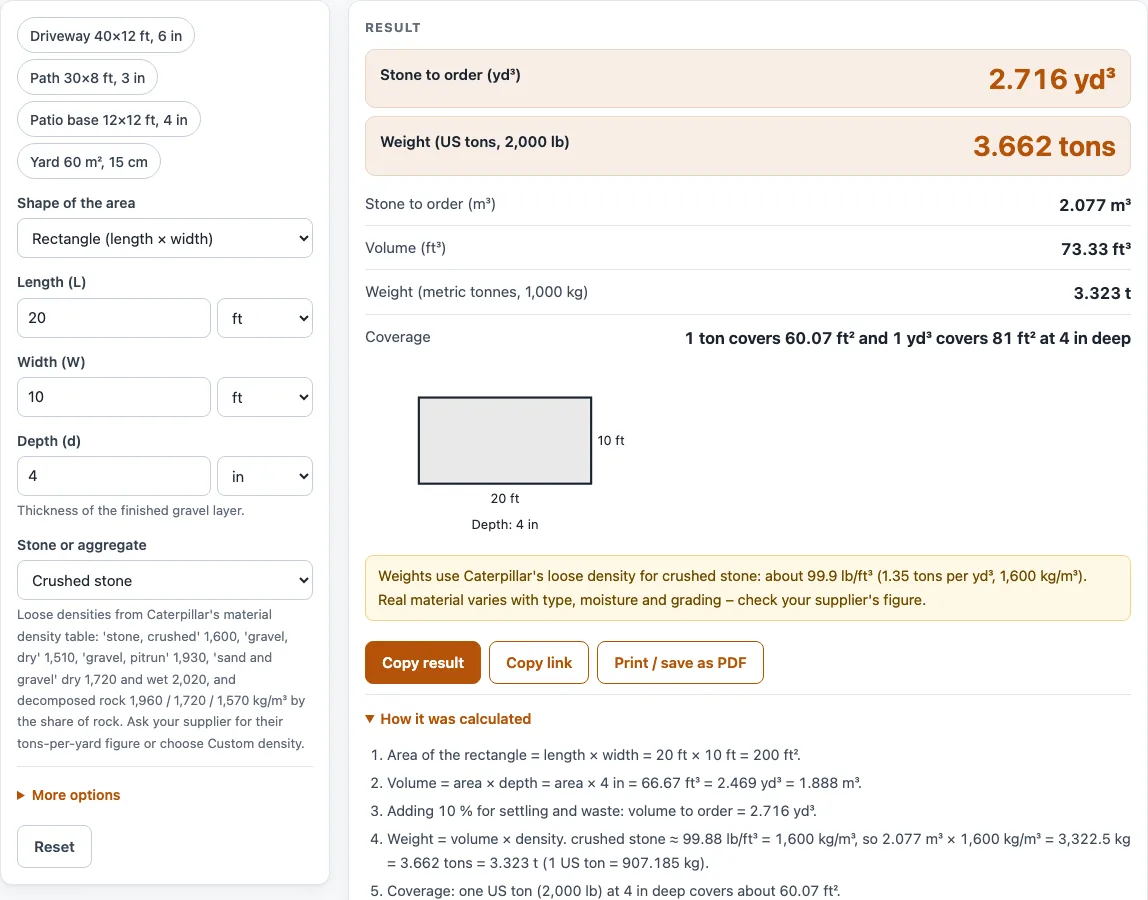
How to use the Stone calculator
- Choose the Shape of the area: Rectangle (length × width), Circle (diameter), Triangle (base × height) or Area already known.
- Fill in the boxes for your shape, each with a unit (ft, in, yd, m, cm or mm), or type the area directly in ft², yd², m², acres or hectares.
- Enter the Depth (d) of the finished layer, not the depth of the pile.
- Choose the Stone or aggregate: crushed stone, gravel (dry or pit-run), sand and gravel (dry or wet), or decomposed rock with 75, 50 or 25 % rock. For Custom density, type the Bulk density and its unit; your supplier’s tons per cubic yard is the best value.
- Open More options to change Extra for settling and waste (%), which starts at 10, and to enter an optional Price per US ton, tonne, cubic yard or cubic meter.
- Read the results: the volume to order, the weight in tons or tonnes and the coverage per ton at your depth. Then open How it was calculated to check each step with your numbers.
The example buttons (Driveway 40×12 ft, Path 30×8 ft, Patio base 12×12 ft, Yard 60 m²) load a complete calculation you can change. Reset restores the defaults, Copy link saves every input in the page address and Print / save as PDF prints your inputs, results, steps and the date.
How much stone do I need?
Multiply the area by the depth to get the volume, then add an allowance for compaction and spillage. A rectangle’s area is length × width, a circle’s is π × (diameter ÷ 2)² and a triangle’s is ½ × base × height. For a 20 ft × 10 ft area at 4 in deep, the volume is 66.67 ft³, or 2.469 yd³, and with the default 10 % extra it is 2.716 yd³. One cubic yard is 27 ft³ and covers 81 ft² at 4 in deep, 54 ft² at 6 in and 162 ft² at 2 in.
How many tons of stone are in a cubic yard?
It depends on the material. The tool uses the loose densities in Caterpillar’s material table. Crushed stone is 1,600 kg/m³, which is about 1.35 US tons per cubic yard. Dry gravel is 1,510 kg/m³ (1.27 tons), pit-run gravel 1,930 (1.63 tons), and sand and gravel 1,720 dry (1.45 tons) or 2,020 wet (1.70 tons). Decomposed rock is 1,960, 1,720 or 1,570 kg/m³ for 75, 50 or 25 % rock (1.65, 1.45 and 1.32 tons per yard). For the 20 ft × 10 ft × 4 in example the weight is 3.66 US tons of crushed stone.
One ton of crushed stone covers about 60 ft² at 4 in deep, 40 ft² at 6 in and 120 ft² at 2 in. The results show the coverage for your own depth, in both tons and cubic yards.
What about road base, crusher run, 57 stone and landscape rock?
These names describe grading and use, not a separate density in the table. Road base and crusher run are crushed stone mixed with fines, 57 stone and 57 gravel are crushed stone of one size, and landscape rock and landscape stone are decorative stone laid over a bed. For all of them, calculate the volume from the area and the depth, and start with Crushed stone for the weight. Then replace the density with your supplier’s tons per yard under Custom density, because their stone, its size and its moisture decide the real figure. For crushed concrete use the same method with the supplier’s figure.
Which material row should I pick for tonnage?
Pick the row closest to what the supplier calls the material, and treat it as a starting value. A 1.35 versus 1.27 tons per yard difference between crushed stone and dry gravel is about 6 %, which matters for a large order priced by the ton. Wet material weighs more than dry material, and sand and gravel gains about 17 % from the dry to the wet row (1.45 to 1.70 tons per yard). If you want a river rock coverage figure for decorative stone, use the river rock calculator, which also checks the depth against the stone size.
Sources
Worked examples
| Input | Result |
|---|---|
| 20 ft × 10 ft, 4 in deep, crushed stone | 2.716 yd³ (2.077 m³), 3.662 tons |
| 40 ft × 12 ft, 6 in deep, sand and gravel, dry | 9.778 yd³ (7.476 m³), 14.17 tons |
| 60 m², 15 cm deep, crushed stone | 9.45 m³ (12.36 yd³), 15.12 t |
| 30 ft × 8 ft, 3 in deep, decomposed rock, 50 % rock | 2.444 yd³ (1.869 m³), 3.543 tons |
Calculated by the tool above with these values.
Frequently asked questions
Is the calculator free, and is anything I type uploaded?
Yes, it is free. It runs entirely in your browser, needs no sign-up, and nothing you type is uploaded.
How many tons of crushed stone do I need for a driveway?
For a 40 ft × 12 ft driveway with 6 in of crushed stone and 10 % extra, the volume is 264 ft³ (9.78 yd³), or about 13.2 US tons at 1,600 kg/m³. Use your own length, width and depth, and confirm the tons per yard with the supplier.
How do I convert cubic yards of stone to tons?
Multiply the cubic yards by the tons per cubic yard of the material: about 1.35 for crushed stone and 1.27 for dry gravel with this tool’s densities. The calculator does this for you and also shows metric tonnes. For a plain volume-to-weight conversion of any material, see the cubic yards to tons calculator.
Is this the same as the gravel calculator?
The method is the same: area × depth × density. This page lists more aggregate types (pit-run, sand and gravel, decomposed rock) and focuses on tons and coverage per ton. For gravel with bag counts, use the gravel calculator.
Can I use the results in commercial work such as quotes and bids?
Yes. The quantities, steps and printouts can be used in any work, including estimates, quotes, bids and material orders, and no attribution is needed. Confirm final quantities with your supplier before you order.
Should I always add 10 % extra?
The default is 10 %, a starting value for compaction and spillage. Use 0 for the exact volume, or the figure your contractor or supplier suggests.
Related tools
- Gravel calculator: use it for gravel, pea gravel and river rock with bag counts.
- River rock calculator: use it for decorative rock, with a depth check against the stone size.
- Cubic yards to tons calculator: use it to convert any volume into tons.
- Sand calculator: use it for dry and wet sand and bags.
- Dump truck capacity calculator: use it to count truck loads.
- All calculators: use it to browse every tool on the site.